
25 Years After 9/11, Documents Reveal Saudi Elite Funding for Al-Qaeda
Christophe Ayad, Guillaume Dasquié | Le Monde | October 18, 2026
Read the full article HERE.
In New York on September 11, 2026, a woman walked up to the podium at the ceremony marking the 25th anniversary of the attacks. A solemn row of former presidents stood nearby: George W. Bush, Bill Clinton, Barack Obama, Joe Biden. Terry Strada, president of the 9/11 Families United advocacy group representing families of the victims, looked straight ahead, her throat tight for a moment. “We finally made it into a court and (…) proved that the Kingdom of Saudi Arabia fomented a rancid culture of anti-American terrorism,” she said. “But, for 25 years, administration after administration, including leaders in front of us here today, chose to protect the Saudis.” Some VIPs stiffened. The crowd applauded.
To understand Strada’s deep-seated anger, it’s necessary to look at the lawsuit brought by the victims of 9/11, which is still ongoing in a Manhattan courthouse. To date, 12,000 legal filings have been recorded in the case. The timeline of the documents reveals the delays and obstacles facing the plaintiffs. It has taken two decades to gradually force the federal government to release key information it held about Al-Qaeda, its sponsors and its networks. Since December 2024, the gradual inclusion of reports from the CIA and the US Treasury has begun to fill the gap.
What they reveal is staggering, because the release of the intelligence reports alters the image of the terrorist movement, particularly when it comes to financial backers. Osama bin Laden and Al-Qaeda no longer appear as renegades who had fallen out of favor in the Wahhabi kingdom, isolated in the Afghan mountains among the Taliban since 1996. They no longer resemble mere fanatics sporadically aided by a handful of merchants.
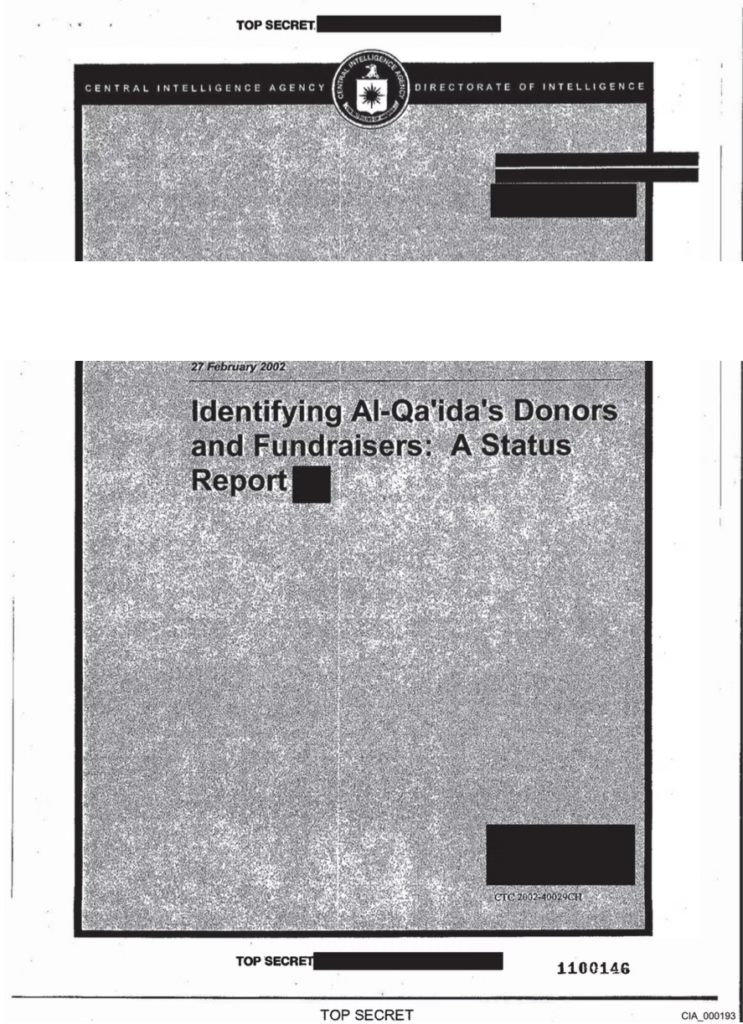
A declassified CIA report published online in 2024 as part of the civil proceedings brought by the families of 9/11 victims against the Saudi state. US DEPARTMENT OF JUSTICE
As the pages unfold, an alternative narrative emerges. According to the long-inaccessible CIA notes, Al-Qaeda and its leader survived thanks to the patronage of a segment of the Saudi bourgeoisie and the backing of several religious elites until at least 2003. The notes reveal just how powerless the ruling family was to stop these forces, with some leaders even choosing to look the other way. This risked upsetting many diplomatic interests. “A few Saudi government officials, such as Prince Nayif [the unmovable interior minister from 1975 to 2012] and Saudi Embassy personnel [in the United States], have condoned or ignored the activities of NGOs [non-profit organizations] and NGO representatives that support terrorist and militant groups,” CIA analysts wrote nearly a year after the attacks.
These assertions came from a CIA summary dated November 14, 2002. The document, classified “top secret,” is titled “Saudi-Based Financial Support to Terrorist Organizations.” Fourteen months after the collapse of the Twin Towers, the intelligence service compiled its information on Al-Qaeda’s funding. The introduction reads like a verdict: “Saudi Arabia is a key base of financial support for Al-Qaeda and several other terrorist organizations. We estimate that since the mid-1990s, several tens of millions of dollars a year has flowed to terrorists from a variety of sources in the Kingdom. (…) Al-Qaeda has relied on its network in Saudi Arabia (…) for several years. Money that originates in the Kingdom is dispersed to Al-Qaeda members operating in Pakistan and Afghanistan.” The CIA further specified it believed “half or more of Al-Qaeda’s estimated pre-9/11 budget” was raised in the country.
From ordinary donors to business leaders
Specifically, who was giving, and how did the money reach the jihadists? The intelligence service distinguishes between two categories of contributors. The first consists of ordinary citizens, who may be more or less unaware: “A portion of the income that Al-Qaeda and other groups count on is derived from legitimate religious contributions, where the donor is either unwitting, misled or inclined to look the other way.”
The other category, according to the CIA, includes prominent business figures. “We have identified several wealthy Saudi individuals and families we suspect of supporting the Al-Qaeda network. Many of these donors come from prominent merchant families in Jeddah, and they probably account for the largest share of Al-Qaeda’s income.” Then, over three pages, the CIA details the cases of six individuals and the information justifying its accusations. They are well-known bankers and entrepreneurs. To date, none of these men has ever been convicted of funding terrorism, either in Europe or in the US. They must therefore be presumed innocent.
As for the route taken by the money, the report, along with several other intelligence memos submitted to the courts and reviewed by Le Monde, emphasizes the role of three charitable and religious organizations: the International Islamic Relief Organization, the Al-Haramain Foundation and the Muwafaq Foundation. The first two, which operate in many countries, have long-standing and close ties with the Muslim World League overseen by Saudi religious authorities, and several of their branches were at one time listed as terrorist entities by the United Nations or the European Union. The third, Muwafaq, which is smaller in scale, has an extraordinary history. According to memos from several intelligence services, it not only passed on weapons and funds to Al-Qaeda, but it worked directly with the Maktab Al-Khadamat, a suspected Al-Qaeda front in the Pakistani city of Peshawar, near the Afghan border, to the point where staff from both organizations were indistinguishable.
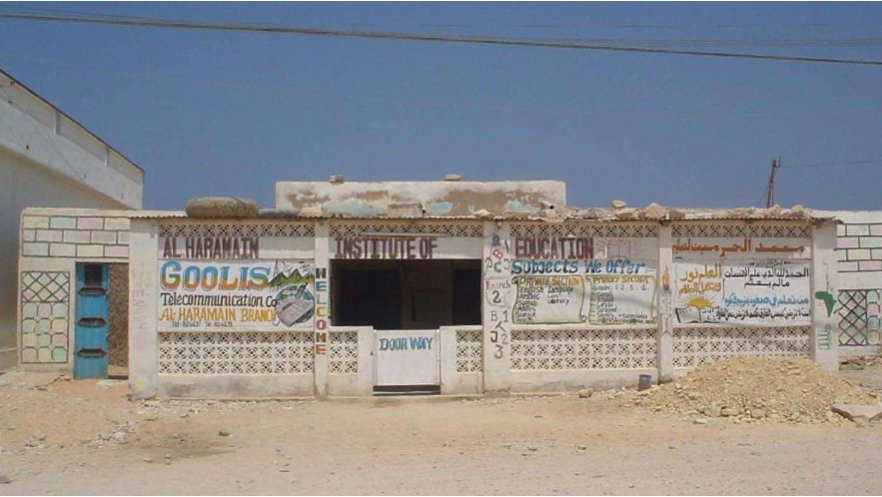
The Al-Haramain Foundation’s offices in the port city of Bossasso, Somalia, February 2004. STR/AP/SIPA
For this reason, the Saudi founder of Muwafaq, Yassin Qadi, also appears on the CIA’s list of major donors. The businessman has always denied knowingly funding Al-Qaeda. To defend himself, in August 2002, he agreed to answer a series of questions submitted by a team from the US Treasury Department. His explanations, written from a tower in the business district of Jeddah, fill a 107-page document. It delves into the inner workings of the entity, where wealthy individuals and jihadists crossed paths. But, when faced with the Treasury’s most uncomfortable questions, the businessman responded with surprise and naivety.
Born in 1955 of Egyptian origin and trained as an architect, Qadi launched his business career in Chicago and Jeddah, and soon turned his attention to the financial sector. In the late 1980s, lending institutions in the Middle East offered few services that were strictly compatible with the Quran. He saw an opportunity. “In 1990, I developed a professional relationship with KBM [Khaled Ben Mahfouz] concerning the introduction of Islamic banking products at the National Commercial Bank [NCB], the largest and oldest bank in Saudi Arabia,” he said. This institution, founded in 1953, grew alongside the royal family. The man he mentioned, Khaled Ben Mahfouz, who at the time owned NCB, was part of the Saudi financial elite until his death in 2009. And while he is also mentioned on the CIA’s list and other recently declassified US State Department documents, he has always strongly denied knowingly transferring funds to terrorists. Contacted by Le Monde, lawyers for the Ben Mahfouz family did not respond.
Officially recognized as a charity
In Washington, the justice system already examined Mahfouz’s affairs in the early 1990s. The Federal Reserve had brought proceedings against him after the collapse of a bank in which he was a shareholder, the Bank of Credit and Commerce International. The institution had participated in funding the Afghan mujahideen, which the young bin Laden had joined during the war against the Red Army, a conflict supported by the US and Saudi Arabia.
Qadi entered the picture shortly after these events. “In addition to our business relationship, I have carried out extensive humanitarian activities in conjunction with KBM through the Muwafaq Charitable Foundation, which I established at his request in 1992,” he added in his deposition. “KBM told me he wanted to set up a charitable foundation in memory of his parents. (…) Muwafaq [is] an Arabic word which means, in essence, ‘blessed success.'” A lengthy memo from the US Treasury Department confirms part of his account. The Muwafaq Foundation was indeed registered in May 1992 in Europe, on the island of Jersey, with the stated purpose of charitable activities. However, US officials did not appear to believe this was a coincidence. “Qadi has business dealings with members of the Ben Mahfouz family, who have been linked to Al-Qaeda and Bin Laden,” they wrote. They noted that, up until the early 2000s, Muwafaq operated in Sudan, Somalia, Afghanistan and the former Yugoslavia, all conflict zones where jihadists, including those from Al-Qaeda, were active at the same time.
In Bosnia, Muwafaq assisted the local population in its fight against Serbian militias. As its staff transited through Germany, Berlin’s intelligence services monitored them. In several memos, they detailed Muwafaq’s banking and logistical operations benefiting Al-Qaeda members who had gone to wage jihad in Bosnia. Qadi swore he was unaware of this, despite his numerous contacts with local Muwafaq officials, whom he had personally recruited.
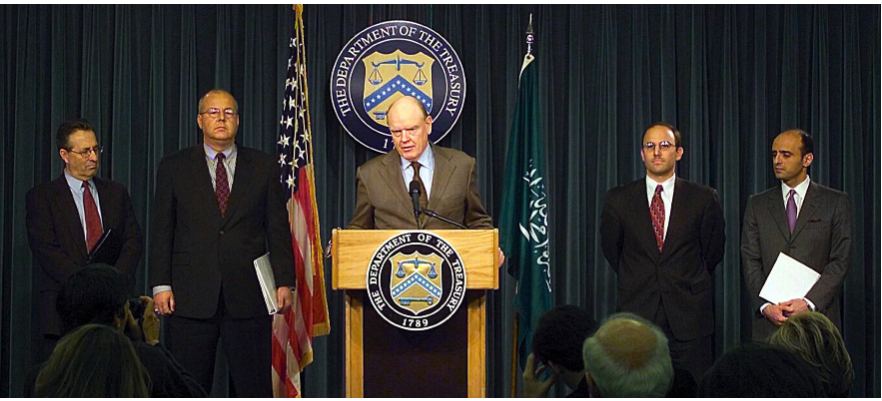
US Treasury Secretary John Snow (center) announces sanctions against four branches of the Saudi charity Al- Haramain Foundation for funding Al-Qaeda, January 22, 2004. AFP
It would be an understatement to say that he did little to convince US Treasury investigators. “There are far too many reports, originating from too many sources, pointing at too many different entities and individuals (…) associated with [Qadi] that have connections to terrorism, and dating over too long a time period, to give credence to a defense that all of the reports are in error,” they stated. “The totality of the evidence, both classified and unclassified, provides a reason to believe [Qadi] has funded terrorist and extremist individuals and operations.”
Even his timeline of events raises questions. The businessman cited records stating that Muwafaq was shut down before 1998, the year bin Laden’s terrorist ambitions against Washington materialized with attacks on US embassies in Kenya and Tanzania. However, according to the US Treasury, Muwafaq’s teams and those of Al-Qaeda were still closely collaborating on the ground, along the Afghan border, three years later, until summer 2001. From Jeddah, Qadi insisted that he was no longer running the foundation at that time. He said he was instead focusing on developing Islamic banking products for the NCB through a dedicated subsidiary, which he claimed to have chaired until that critical year of 2001, as evidence of his innocence. When contacted by Le Monde, Qadi’s lawyer reiterated that he “has always denied that he ever supported any terrorist group in any manner [and he] has never been convicted of any crime, or found civilly liable for any claim, relating to 9/11, terrorism or terrorism financing.”
The Muwafaq case was not an exception. Other Saudi charitable foundations met similar fates. In this context, successive US administrations tried to curb the funding of terrorism coming from the kingdom after 9/11 by favoring a code of silence.
As early as 2002, in black and white, the CIA urged political leaders to settle these matters privately: “A key factor for continued successful counterterrorism initiatives with the Saudis, whose society is by tradition private, closed and conservative, will be to ensure that their cooperation with the United States is handled discreetly and kept as much as possible out of the public eye.”
###